
Community
Some Wisconsin monarchs have made it to Mexico months after being tagged months ago
By Katherine Langford
Advertisement · Why this ad?
Marcus manages the day-to-day editorial workflow across all brands, coordinating coverage assignments and ensuring editorial standards are met. He previously served as city editor at the Pioneer Press and holds a degree in Political Science from Carleton College.
More from Marcus →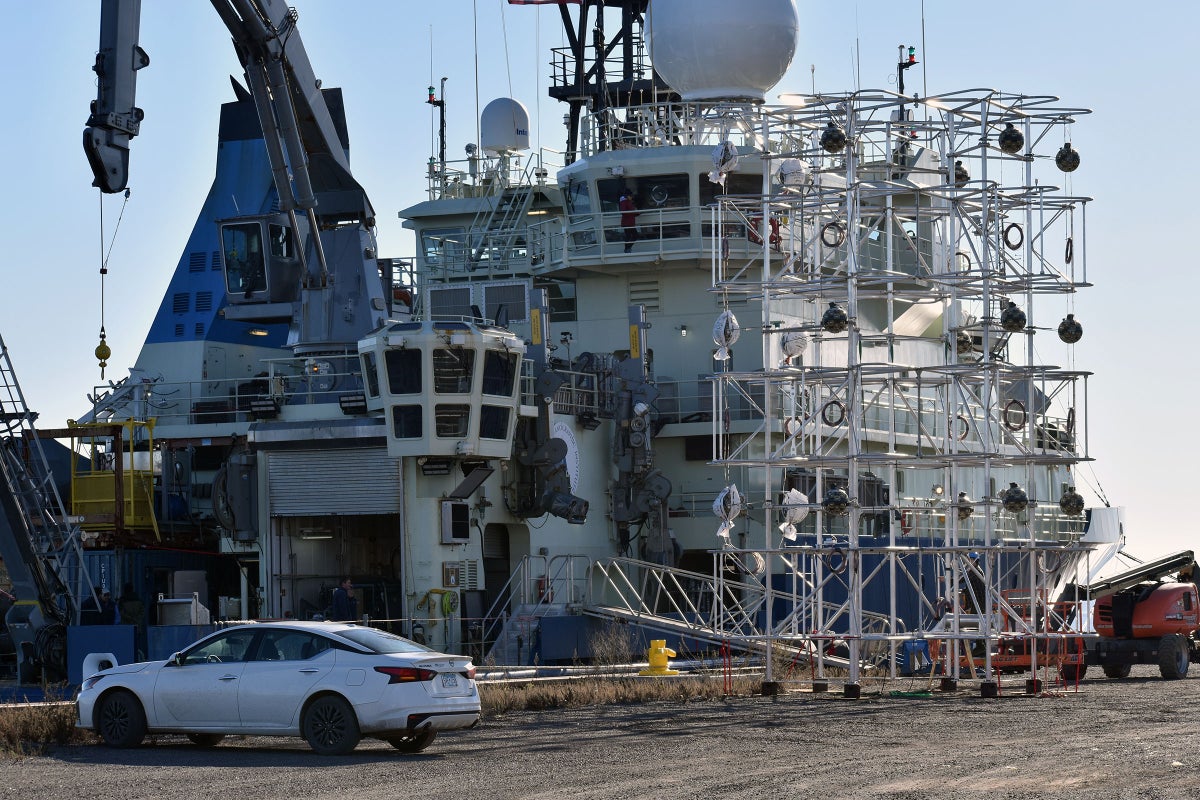
The bottom of Lake Superior will be the latest laboratory for researchers hoping to learn more about neutrinos — also known as ghost particles Neutrinos are tiny cosmic particles that have no electric charge, and they’re famously hard to find because of their extremely small mass. Despite that, they’re among the most abundant particles in the universe. They are called ghost particles because trillions of them move through people every second without interacting with them, according to the U.S. Department of Energy. Now, researchers are conducting the Experimental Neutrino Detector, or END, project in Lake Superior. They want to distinguish a beam of neutrinos generated at the Illinois-based Fermi National Accelerator Lab , or Fermilab, from the tiny cosmic particles that already exist in the background. Understanding Wisconsin, Together. WPR’s “Wisconsin Today” newsletter keeps you connected to the state you love without feeling overwhelmed. No paywall. No agenda. No corporate filter. Instagram This field is for validation purposes and should be left unchanged. Email Subscribe The project is led by the University of Minnesota-Duluth. Alec Habig is the principal investigator on the project and a physics professor at UMD. “Neutrinos don’t go through everything totally. Some of them get really unlucky, trip over an atom. If that atom is in your detector, you get to see the particles that it knocks loose,” Habig explained at a press conference in Duluth. The project is said to cost tens of millions of dollars. It will place underwater neutrino detectors on the bottom of the lake in the path of the Fermilab neutrino beam that passes through Lake Superior near Two Harbors. Since 2005, Fermilab has aimed a beam of the tiny particles from Illinois toward the no longer operating Soudan Mine Underground Lab and the currently operating NOvA Far Detector Facility in Minnesota. Habig said that beam goes right under Wisconsin and eclipses Lake Superior near Two Harbors on its way to the labs in northern Minnesota. “The more neutrinos get unlucky, the more stuff you have to trip over them, right? Water is a lot of stuff, and so it’s a way to make a very big neutrino detector with Mother Nature supplying the parts,” Habig said. He noted University of Wisconsin-Madison professor Francis Halzen recently won a Nobel Prize in physics for his neutrino research in ice at the IceCube Neutrino Observatory in Antarctica. Scientists have long studied neutrinos using detectors in the ice, underground and underwater. The detectors in the END project will use underwater photosensors developed by the KM3NeT collaboration where researchers have studied neutrinos deep under the Mediterranean Sea. In the Mediterranean, sensors are deployed in long vertical strings. Metal frames mounted with sensors are being installed on the bed of Lake Superior. Kyle Zeug is a mechanical engineer with UW-Madison’s Physical Sciences Lab. He helped assemble ladders that contain the photosensors and hoist them on the frames. “It’s basically a string of Christmas lights. You can’t disconnect the cable between each of them. You can’t damage it in any way, so it’s a real kind of delicate work,” Zeug said. There are five 33-feet tall metal frames with 18 spherical neutrino detectors mounted to each frame. The neutrino detectors are about the size of a beach ball. The 238-feet research vessel (R/V) Neil Armstrong from the Woods Hole Oceanographic Institution in Massachusetts will transport the frames and mounted sensors several miles offshore Two Harbors, Minnesota. Kent Sheasley, one of the vessel’s captains, said the crew will use a crane to lower the frames, which each weigh about 8,000 pounds , about 689 feet down to the lakebed. “There will also be a cable that will be attached as we set it down on the lake floor,” Sheasley said. “Then we’re going to run that cable back to just off of Two Harbors, where we’re going to pass it off to a barge. (Divers are) going to handle getting it actually onto the beach and attached as necessary.” Habig said the first frame will be installed later this week, and researchers will start taking data from the sensors as soon as the fiber-optic cables are plugged in. When a neutrino hits an atom in water, any visible particles that are knocked loose travel about 33 feet and stop. As the charged particle travels along, Habig said it creates a bluish light, known as a Cherenkov light , that the sensors can detect. “We can connect the dots and see it went from here to here, and tell that it’s coming from the direction of Fermilab and not other cosmic radiation coming down from above,” Habig said. He added that they expect the project will detect several neutrinos each week from the Fermilab beam to see if they can better understand them before the beam is shut down early next year. A larger beam is being built for the new Deep Underground Neutrino Experiment or DUNE. The vessel named for the first man to walk on the moon is helping scientists explore and answer fundamental questions, said Rob Munier, vice president of marine facilities and operations with the Woods Hole Oceanographic Institution. “What we’re doing here at the bottom of Lake Superior is nothing less than the exploration of the cosmos to help answer the question: Why do we live in a matter-dominated universe? Or put more simply, why are we here?” Munier said. When the experiment is done, the sensors will be retrieved and sent back to Italy to be put in the Mediterranean Sea. But the cables will remain on the lakebed, and the university will put sensors on them to better understand what’s happening in Lake Superior. The Defense Advanced Research Projects Agency , or DARPA, within the U.S. Department of Defense is sponsoring the project. John Bruzzese, project manager for DARPA, said it doesn’t have a specific application in mind for the END project, saying it’s a scientific venture. “These are the most abundant particles in the universe. We know very little about them. As science moves forward, it’s important that we are tracking human understanding of this science, so that we can begin imagining what is possible in the future,” Bruzzese said. The Department of Energy’s Office of Science, Fermilab and Brookhaven National Lab are also collaborating on the effort. Wisconsin Public Radio, © Copyright 2026, Board of Regents of the University of Wisconsin System and Wisconsin Educational Communications Board. Related Stories Latest Wisconsin Nobel Prize winner shares how scientific collaboration enabled cosmic discoveries UW-Madison professor who hunts mysterious particles in Antarctic ice wins Nobel Prize for physics $35M Will Help UW South Pole Project Try To Unlock More Cosmic Secrets
By Katherine Langford

By Marcus Chen
By Katherine Langford

By Marcus Chen